
WELCOME BONUS 300%
UP TO €2000 + 100
FREE SPINS
UP TO €2000 + 100
FREE SPINS
Home → Blackjack
Blackjack at Jolly Sweeps Casino
Stop the Session After a 30 Percent Loss
A session stop after a 30 percent loss works as a fixed boundary, not as a strategy that changes the house edge. Blackjack Liberal Vegas Strip keeps a house edge of 0.28 percent with perfect basic strategy, so the stop rule merely limits the amount exposed to that edge in any one sitting.
Compared with Blackjack Insurance at a 7.47 percent house edge, a player who stops after losing 30 percent of a session budget protects the bankroll from the fastest-draining side bet. On a 200 € session, the stop triggers when losses reach 60 €, leaving 140 € unspent.
The stop point also interacts with bet sizing at tables such as Lightning Blackjack, where the range runs from 1 € to 2,500 €. A player using 10 € base bets hits a 60 € loss after six lost rounds, while someone at 25 € reaches the same stop after fewer than three lost rounds.
RNG Deals From a Virtual Eight-Deck Shoe
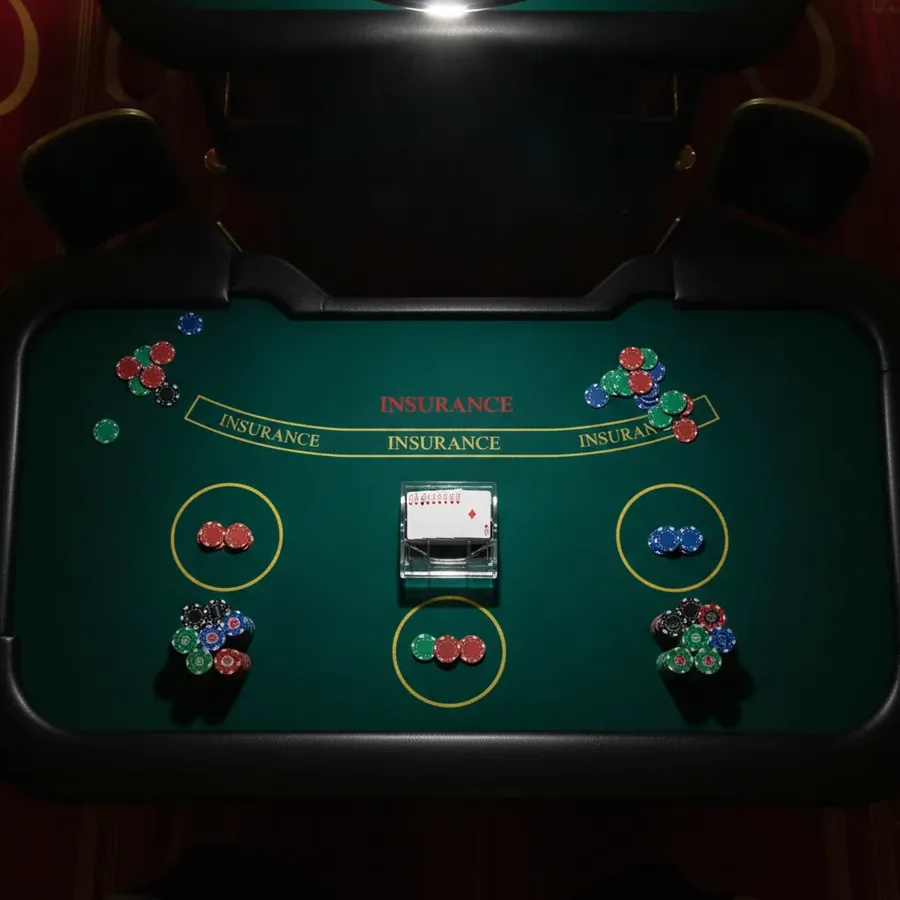
The RNG in digital blackjack draws from a virtual eight-deck shoe as the baseline for card distribution. The single-deck classic game with a 3:2 payout shows a house edge of 0.15 percent, while eight decks push the edge upward by about 0.48 percentage points before other rules are applied.
A six-deck shoe with S17, DAS, DOA and a 3:2 payout carries a house edge of 0.46 percent under basic strategy. The rule modifier for six decks instead of eight is worth only about 0.02 percentage points, a much smaller shift than the 1.39-point jump caused by replacing 3:2 with a 6:5 payout.
The virtual shoe size matters because fewer decks lower the edge. Blackjack Liberal Vegas Strip with its liberal rules reaches an RTP of 99.72 percent and a house edge of 0.28 percent, far below the 1.85 percent edge of a six-deck 6:5 game.
The 3:2 Blackjack Payout Explained
A 3:2 blackjack payout pays 150 € on a 100 € stake, while a 6:5 payout returns only 120 € for the same stake. That 30 € difference on a single blackjack is not a rounding detail; it is a structural cut to the winning hand.
The switch from 3:2 to 6:5 on a six-deck shoe adds exactly 1.39 percentage points to the casino's edge. The 6:5 game shows an RTP of 98.15 percent and a house edge of 1.85 percent, while the same six-deck game with S17, DAS, DOA and a 3:2 payout sits at 99.54 percent RTP and a 0.46 percent edge.
On a 10 € bet, a 6:5 blackjack pays 12 € instead of 15 €. Over time that loss of 3 € per blackjack compounds, which is why the 3:2 payout remains the single most important rule on any table, ahead of surrender, resplitting or doubling after a split.
Even Money only possible with Dealer Ace
Even money becomes an option only when the dealer shows an ace and the player holds a blackjack. The offer pays the win at 1:1 immediately instead of risking a push if the dealer also has blackjack, but the insurance behind it carries a house edge of 7.47 percent on a six-to-eight-deck shoe.
The separate insurance side bet allows up to 50 percent of the main bet and pays 2:1 if the dealer's hole card completes a blackjack. Basic strategy always declines insurance in a six-to-eight-deck game, except for card counters at a true count of at least +3.
A single-deck insurance bet has an edge of about 5.88 percent, still far above the 0.28 percent edge of Blackjack Liberal Vegas Strip. Accepting even money means taking certainty, but the cost is a side bet with one of the worst returns on the layout.
Six to Eight Decks in the Shoe
The move from six decks to eight decks changes the edge by about 0.02 percentage points, a negligible shift compared with other rule differences. The six-deck benchmark with S17, DAS, DOA and a 3:2 payout shows an RTP of 99.54 percent and a house edge of 0.46 percent.
Single-deck blackjack with classic rules and a 3:2 payout reaches an RTP of 99.85 percent and a house edge of 0.15 percent. The single deck lowers the edge by about 0.48 percentage points compared with eight decks, but many single-deck tables offset that advantage by switching to a 6:5 payout.
Rule effects are larger: dealer hitting soft 17 adds 0.22 percentage points, resplitting aces improves the player by 0.08 points, and doubling after a split improves it by about 0.14 points. Late surrender in Blackjack Surrender improves RTP by roughly 0.08 percentage points.
Blackjack variants at a glance
| Variant | Payout | House edge | Rule | RTP |
|---|---|---|---|---|
| Blackjack Liberal Vegas Strip (liberal rules, 3:2) | Blackjack 3:2, win 1:1 | 0.28% | The most player-friendly rule set: S17 + DAS + resplit + late surrender. Standard deviation 1.15 | 99.72% |
| Blackjack Insurance (6–8 decks) | Insurance 2:1 | 7.47% | Separate side bet of up to 50% of the main bet when the dealer shows an ace. Basic strategy ALWAYS declines it (except for card counters at a true count ≥ +3). With a single deck the edge is ≈ 5.88% | 92.53% |
| Blackjack Split / double / H17 – rule effects | Double – stake ×2 with one card; split – up to 4 hands; split aces usually get one card each. | H17 +0.22 percentage points; RSA −0.08 percentage points; DAS −0.14 percentage points | Dealer hitting soft 17 lowers RTP by 0.22 percentage points; resplitting aces improves it by 0.08 percentage points; doubling after a split improves it by about 0.14 percentage points; 6 decks instead of 8 – about 0.02 percentage points. | n/a (rule modifiers) |
| Blackjack Single deck, classic rules, 3:2 | Blackjack 3:2, win 1:1 | 0.15% | Fewer decks = lower edge; one deck gives about −0.48 percentage points compared with 8 decks. Often offset by a 6:5 payout. | 99.85% |
| Blackjack 6 decks, S17, DAS, DOA, 3:2 payout, basic strategy | Blackjack 3:2, regular win 1:1, insurance 2:1 | 0.46% | Dealer stands on soft 17; double down on any first two cards; doubling after a split allowed; no surrender. Basic strategy is required to reach this figure | 99.54% |
| Blackjack 6:5 payout instead of 3:2 (6 decks) | Blackjack 6:5, win 1:1 | 1.85% | Replacing 3:2 with 6:5 adds exactly +1.39 percentage points to the casino's edge – more than any other rule change. On a €10 bet a blackjack pays €12 instead of €15. | 98.15% |
When Can You Raise Your Bet?
Doubling down is the moment a blackjack player can increase the bet, and it works as stake x2 with one card to follow. In a six-deck game with S17, DAS, DOA and a 3:2 payout, doubling after a split is allowed and basic strategy is required to reach an RTP of 99.54%, a house edge of 0.46%.
The effect of that rule is measurable: doubling after a split, known as DAS, improves the return by about 0.14 percentage points. Compared with a 6:5 payout, which adds exactly 1.39 percentage points to the casino's edge, DAS is a small but real gain for the player.
On a €10 bet a blackjack pays €12 at 6:5 instead of €15 at 3:2, so three euro are lost on every natural. Late surrender is the other way to limit exposure: the player gives up the hand after the dealer has checked for blackjack and loses half the stake, which improves RTP by about 0.08 percentage points.
What the Peek Means When the Dealer Shows an Ace
When the dealer shows an ace, insurance is offered as a side bet of up to 50% of the main bet and pays 2:1. In a six to eight deck game that side bet carries an RTP of 92.53% and a house edge of 7.47%, so basic strategy always declines it except for card counters at a true count of +3 or higher.
A single deck changes the picture: the edge on insurance is about 5.88%, still far above the 0.46% house edge of a six-deck game with S17, DAS, DOA and a 3:2 payout. On a €10 main bet the maximum insurance stake is €5, and that €5 sits in a bet with a 7.47% house edge.
The peek itself is what lets late surrender work, because the player gives up the hand after the dealer has checked for blackjack. That surrender option is worth about 0.08 percentage points of RTP, against 7.47% for insurance, so the two decisions on a dealer ace point in opposite directions.
Infinite Blackjack vs the Classic Seven-Seat Table
Infinite Blackjack from Evolution runs with unlimited seats at the table, a bet range of 1 - 5,000 EUR and four side bets: Any Pair, 21+3, Hot 3 and Bust It. Its RTP is 99.47%, which is below the 99.54% of a six-deck table with S17, DAS, DOA and a 3:2 payout.
A classic table seats seven players, while Infinite Blackjack from Evolution removes that cap entirely and still keeps the 1 - 5,000 EUR range. The trade-off is visible in the figures: 99.47% against 99.54% is 0.07 percentage points of return given up for unlimited seating and four side bets.
At a €100 stake the difference between those two RTP figures is about €0.07 per round in expected return. The side bets are separate wagers on top of the main hand, so they add their own cost, while the 1 - 5,000 EUR range applies to the blackjack bet itself.
Calling Late Surrender Correctly in Three Steps
Step one is the timing: late surrender is available only after the dealer has checked for blackjack, not before. Step two is the price: the player gives up the hand and loses half the stake, so €10 becomes a €5 loss. Step three is the value: the rule improves RTP by about 0.08 percentage points.
That 0.08 percentage points is small next to the 1.39 percentage points that a 6:5 payout adds to the casino's edge, but it points the other way. Early surrender is worth much more, up to 0.6 percentage points, but it is extremely rare, so the late version is what most tables offer.
A liberal Vegas Strip rule set combines S17, DAS, resplit and late surrender and reaches an RTP of 99.72% with a house edge of 0.28% and a standard deviation of 1.15. Surrender is only one part of that package, and it returns 50% of the stake rather than the full amount.
16 vs 10 played incorrectly: most common error
A hard 16 against a dealer 10 is the spot where players most often stand instead of hitting, and the cost shows up in the rule figures. Doubling after a split is worth about 0.14 percentage points and resplitting aces about 0.08 percentage points, yet both are smaller than the 1.39 percentage points a 6:5 payout adds to the edge.
The six-deck benchmark with S17, DAS, DOA and a 3:2 payout sits at an RTP of 99.54% and a house edge of 0.46%, but only when basic strategy is followed. Basic strategy also declines insurance in every six to eight deck game, because that side bet has an RTP of 92.53% and a house edge of 7.47%.
A single deck with classic rules and a 3:2 payout reaches an RTP of 99.85% and a house edge of 0.15%, about 0.48 percentage points better than eight decks. That gain is often offset by a 6:5 payout, which turns a €10 blackjack into €12 instead of €15.
Early Surrender Is Gone From Many Tables
Early surrender is worth up to −0.6 percentage points of house edge, while late surrender at Blackjack Surrender returns only 50% of the stake after the dealer has checked for blackjack. The early version lets a player fold before that check, and that timing difference explains why the more valuable option has largely disappeared from live tables.
Late surrender improves the return by about 0.08 percentage points, which on 100 € of stakes is roughly 8 cents saved per 100 € wagered across many rounds. The gain is real but modest, and it arrives only when the player folds at the correct moment against a strong dealer card.
Blackjack Liberal Vegas Strip carries an RTP of 99.72% and a house edge of 0.28%, and its rule set already includes late surrender alongside S17, DAS and resplit. A player who wants the surrender option in practice will find it there rather than in an early form.
The Insurance Mistake: 7% Extra House Edge
Insurance on 6 to 8 decks shows an RTP of 92.53% and a house edge of 7.47%, which is a separate side bet of up to 50% of the main bet when the dealer shows an ace. A side bet is an extra wager placed alongside the main hand, settled on its own outcome.
On a single deck the insurance edge is about 5.88%, so the six to eight deck version costs the player roughly 1.59 percentage points more. Basic strategy always declines insurance, except for card counters at a true count of +3 or higher, and that exception is narrow.
The payout is 2:1, so a 10 € insurance bet returns 30 € when it wins, yet the long-run return of 92.53% means 100 € of insurance stakes cost about 7.47 € on average. The main bet at Blackjack 6 decks runs an RTP of 99.54% with a house edge of 0.46%, so insurance is far the weaker of the two.
Soft vs Hard Hands in Practice
A soft hand contains an ace counted as 11, and the dealer standing on soft 17 is the S17 rule that supports the 99.54% RTP of Blackjack 6 decks with S17, DAS, DOA and a 3:2 payout. Hitting soft 17 instead lowers the return by 0.22 percentage points, which is the H17 penalty.
Doubling after a split improves the return by about 0.14 percentage points, and resplitting aces adds 0.08 percentage points, so the two rule choices together are worth roughly 0.22 percentage points. On 100 € of stakes that is about 22 cents returned across the sample.
Blackjack Liberal Vegas Strip combines S17, DAS, resplit and late surrender for an RTP of 99.72% and a house edge of 0.28%, with a standard deviation of 1.15. The soft-hand rules sit inside that set, and a player comparing tables can read the value directly from the RTP difference.
What the Hole Card Means at a Live Table
The hole card is the dealer's face-down card, checked for blackjack before late surrender is allowed, and its presence separates the 99.54% RTP of Blackjack 6 decks with S17, DAS, DOA and a 3:2 payout from games where the dealer takes no hole card.
Quantum Blackjack Plus Live from Playtech reaches an RTP of 99.57% with optimal strategy, and its quantum multipliers go up to 1,000x on three-card combinations totalling 21 points. Both titles sit above the 99.47% of Infinite Blackjack, a gap of about 0.10 percentage points at the top end.
Insurance is settled against the hole card when the dealer shows an ace, and that side bet returns 92.53% on 6 to 8 decks with a 7.47% house edge. On a 100 € insurance stake the expected cost is about 7.47 €, which is why basic strategy declines it outside a true count of +3 or higher.
Contact
Live - online chat
Banking









Providers












Jolly Sweeps Casino 2026